- +91-06747962167
- envirogic@gmail.com
- Devswiny-3093, Ravi Talkies Square, Bhubaneswar
- +91-06747962167
- envirogic@gmail.com
- Devswiny-3093, Ravi Talkies Square, Bhubaneswar
Latest Posts
No Posts Found.

Services
Our Services
Bio Medical Waste Management
All human activities produce waste. We all know that such waste may be dangerous and needs safe disposal. Industrial waste, sewage and agricultural waste pollute water, soil and air. It can also be dangerous to human beings and environment. Similarly, hospitals and other health care facilities generate lots of waste which can transmit infections, particularly HIV, Hepatitis B & C and Tetanus, to the people who handle it or come in contact with it.
India generates around three million tonnes of medical wastes every year and the amount is expected to grow at eight per cent annually.
Bio-medical waste means “any solid and/or liquid waste including its container and any intermediate product, which is generated during the diagnosis, treatment or immunization of human beings or animals or research activities pertaining thereto or in the production or testing of biological or in health camps.
Biomedical waste poses hazard due to two principal reasons – the first is infectivity and other toxicity.
Bio Medical waste consists of
- Human anatomical waste like tissues, organs and body parts
- Animal wastes generated during research from veterinary hospitals
- Microbiology and biotechnology wastes
- Waste sharps like hypodermic needles, syringes, scalpels and broken glass
- Discarded medicines and cytotoxic drugs
- Soiled waste such as dressing, bandages, plaster casts, material contaminated with blood, tubes and catheters
- Liquid waste from any of the infected areas
- Incineration ash and other chemical wastes
Bio Medical waste is any waste generated during the diagnosis, treatment or immunization of human beings or animals, in research activities pertaining to or in the production of or testing of biologicals, and all other categories waste generated by healthcare activities.
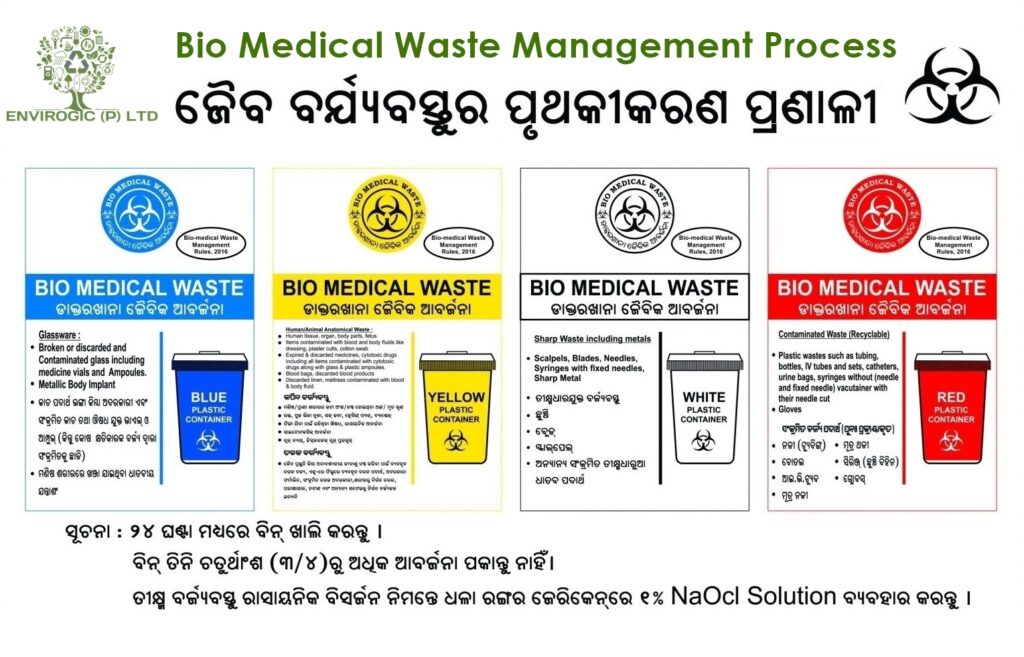
Bio Medical Waste Segregation
- Segregation reduces the amount of waste needs special handling and treatment
- Effective segregation process prevents the mixture of medical waste like sharps with the general municipal waste.
- Prevents illegally reuse of certain components of medical waste like used syringes, needles and other plastics.
- Provides an opportunity for recycling certain components of medical waste like plastics after proper and thorough disinfection.
How does segregation help?
- Recycled plastic material can be used for non-food grade applications.
- Of the general waste, the biodegradable waste can be composted within the hospital premises and can be used for gardening purposes.
- Recycling is a good environmental practice, which can also double as a revenue generating activity.
- Reduces the cost of treatment and disposal (80 per cent of a hospital’s waste is general waste, which does not require special treatment, provided it is not contaminated with other infectious waste)
The bins and bags should carry the biohazard symbol indicating the nature of waste to the patients and public.
Collection
The collection of biomedical waste involves use of different types of container from various sources of biomedical wastes like Operation Theatre, laboratory, wards, kitchen, corridor etc. The containers/ bins should be placed in such a way that 100 % collection is achieved. Sharps must always be kept in puncture-proof containers to avoid injuries and infection to the workers handling them.
Storage
Once collection occurs then biomedical waste is stored in a proper place. Segregated wastes of different categories need to be collected in identifiable containers. The duration of storage should not exceed for 8-10 hrs in big hospitals (more than 250 bedded) and 24 hrs in nursing homes. Each container may be clearly labelled to show the ward or room where it is kept. The reason for this labelling is that it may be necessary to trace the waste back to its source. Besides this, storage area should be marked with a caution sign.
Transportation
The waste should be transported for treatment either in trolleys or in covered wheelbarrow. Manual loading should be avoided as far as for as possible. The bags / Container containing BMWs should be tied/ lidded before transportation. Before transporting the bag containing BMWs, it should be accompanied with a signed document by Nurse/ Doctor mentioning date, shift, quantity and destination.
Special vehicles must be used so as to prevent access to, and direct contact with, the waste by the transportation operators, the scavengers and the public. The transport containers should be properly enclosed. The effects of traffic accidents should be considered in the design, and the driver must be trained in the procedures he must follow in case of an accidental spillage. It should also be possible to wash the interior of the containers thoroughly.
call us now
Have any Question? Ask us anything, we’d love to answer!
Address
Devswiny-3093, Ravi Talkies Square, Bhubaneswar, Odisha
make a call
office :0674-7962167
drop us a line
envirogic@gmail.com